Enterprise AI Architecture & Risk Intelligence Platform
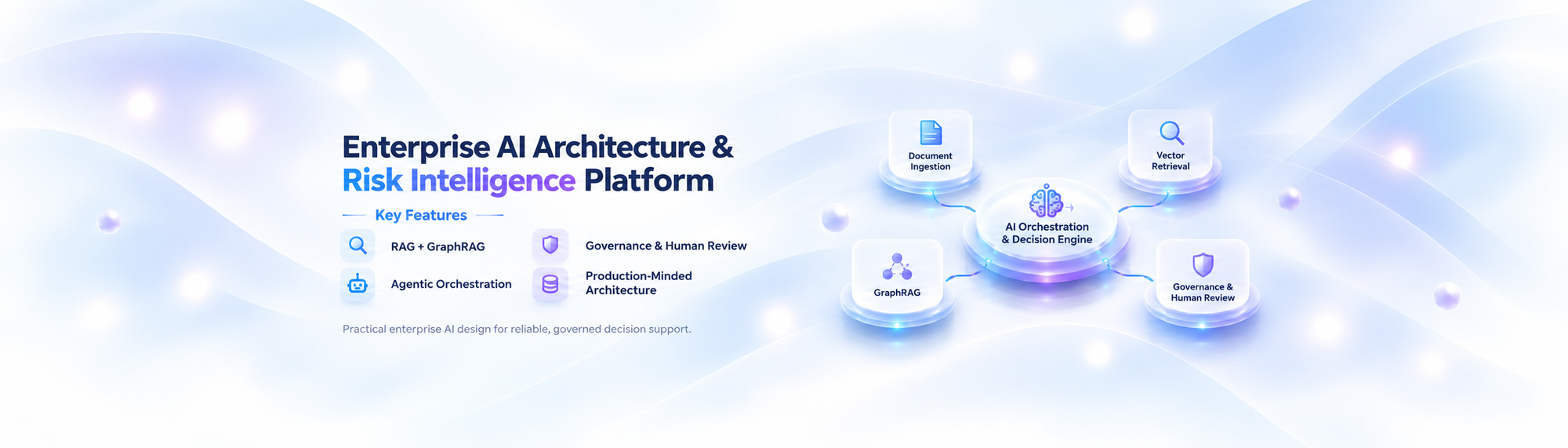
Enterprise AI systems are easy to demo and much harder to operate. Once RAG, agents, enterprise data, human review, security, and governance are involved, the real challenge becomes deciding how much complexity the problem actually requires.
Tech: Python • FastAPI • LangGraph • OpenAI • PostgreSQL/pgvector • GraphRAG • Next.js • Docker • GitHub Actions • OpenTelemetry
ProblemEnterprise teams exploring Generative AI often face a different problem than simply choosing an LLM.The harder questions are:
- Should this workflow use deterministic logic, a single agent, or multiple agents?
- When is standard RAG enough, and when does GraphRAG add value?
- How should evidence, provenance, and unsupported claims be handled?
- Which decisions can be automated, and which should require human review?
- How should identity, permissions, risk controls, and observability fit into the architecture?
- When does additional agentic complexity create value instead of operational risk?
👉 The challenge is not just building an AI workflow — it is designing an architecture that balances capability, reliability, governance, and business value.
Solution
I built the Enterprise AI Architecture & Risk Intelligence Platform, a production-minded reference platform for evaluating and demonstrating enterprise GenAI architecture patterns.The platform combines RAG, GraphRAG, deterministic workflows, single-agent execution, multi-agent orchestration, evaluation, runtime risk controls, and human-in-the-loop review within one architecture.It also separates the public portfolio experience from the authenticated application, with a Next.js frontend, FastAPI backend, PostgreSQL/pgvector data layer, role-based access, OIDC/JWKS authentication, observability, and deployment workflows.The platform is designed around a simple principle:Understand the problem → select the architecture → retrieve evidence → evaluate risk → apply governance → escalate when necessary
Key Features
1. RAG & GraphRAG
- Ingests enterprise knowledge into PostgreSQL/pgvector
- Uses vector retrieval to ground AI-generated outputs
- Adds GraphRAG for relationship-aware retrieval and bounded graph traversal
- Preserves evidence and provenance throughout the assessment workflow
2. Multiple AI Execution Modes
- Supports deterministic workflows
- Supports single-agent execution
- Supports multi-agent orchestration
- Makes it possible to compare when additional agentic complexity is actually justified
The goal is not to default to agents, but to choose the simplest architecture capable of solving the problem reliably.
3. Runtime Risk Gates
- Evaluates AI-generated outputs before finalization
- Can automatically complete low-risk results
- Adds warnings for medium-risk cases
- Routes high-risk cases to human review
- Blocks and escalates critical-risk cases
- Uses machine-readable reason codes for non-automatic outcomes
4. Human-in-the-Loop Review
- Creates an explicit review workflow for higher-risk AI outputs
- Allows authorized reviewers to approve, reject, or request revision
- Preserves previous decisions and review events for traceability
- Separates AI-generated recommendations from final human decisions
5. Enterprise Identity & Security
- Supports authenticated application routes using OIDC/JWKS
- Uses RBAC for analyst, reviewer, and admin permissions
- Validates issuer, audience, expiration, identity, and role claims
- Keeps public showcase pages separate from protected application functionality
6. Evaluation & Governance
- Evaluates architecture outputs across evidence quality, governance, risk, and execution behavior
- Tracks unsupported claims and degraded execution
- Maintains provenance and auditability
- Supports governance-aware architecture assessment without assuming a single industry-specific regulatory framework
7. Observability & Reliability
- Uses structured application logging
- Tracks execution latency, model calls, tool usage, retries, timeouts, degradation, and review activity
- Supports OpenTelemetry-based operational telemetry
- Excludes prompts, private reasoning, embeddings, credentials, and source-document content from telemetry
8. Production-Minded Architecture
- FastAPI backend with PostgreSQL 16 and pgvector
- Next.js, React, and TypeScript frontend
- Docker-based local environment
- Alembic database migrations
- Automated CI checks and PostgreSQL integration testing
- Health and readiness endpoints
- Render backend deployment and Vercel frontend deployment architecture
Enterprise Use Case
The platform is designed around realistic enterprise scenarios where an AI system may need to:
- Search internal policies and documents
- Evaluate evidence before making a recommendation
- Coordinate multiple specialized AI capabilities
- Apply risk and governance rules
- Escalate sensitive cases to human reviewers
- Maintain traceability across AI and human decisions
For example, a regulated organization could use the same architecture pattern to support internal policy analysis, risk assessment, compliance workflows, operational decision support, or enterprise knowledge systems.The project uses synthetic scenarios rather than confidential client data.
What I Wanted to Explore
This project started with one core architecture question:When does additional AI complexity actually improve the solution?Building the platform reinforced an important lesson for me:More agents do not automatically create a better enterprise AI system.In many cases, deterministic workflows or simpler architectures provide stronger groundedness, easier governance, lower operational complexity, and clearer accountability.The goal is to earn complexity through the business problem rather than introduce it by default.